
Last verified 16 November 2026. This is an independent record, not a government site, and nothing here is legal, medical, or real-estate advice.
New York State is offering to test soil, indoor air and sump water at homes on the west end of Cayuga Island, and says the owner pays nothing. The offer is real, but it is spread across two fact sheets and a handful of news reports. This guide puts the steps in order, using only what the state Department of Environmental Conservation (DEC) and Department of Health (DOH) have published, and says plainly where they have not.
New to the story? Start with Cayuga Island: what we know.
Key takeaways
- Testing is voluntary and free. DEC says investigation, any recommended mitigation, cleanup and restoration “will be completed at no cost to the homeowner.”
- There are three kinds of sample: surface soil, sub-slab soil vapor paired with indoor air, and sump water if your home has a sump.
- DEC reaches out to owners in the areas it is studying. Owners in the investigation area who were offered testing earlier and never arranged it can still contact DEC.
- Results go to the owner directly. DEC has published no results for individual properties.
- DEC says winter is the best time to test for soil vapor intrusion, so it asks for timely replies.
Step 1: Find out whether the offer covers you
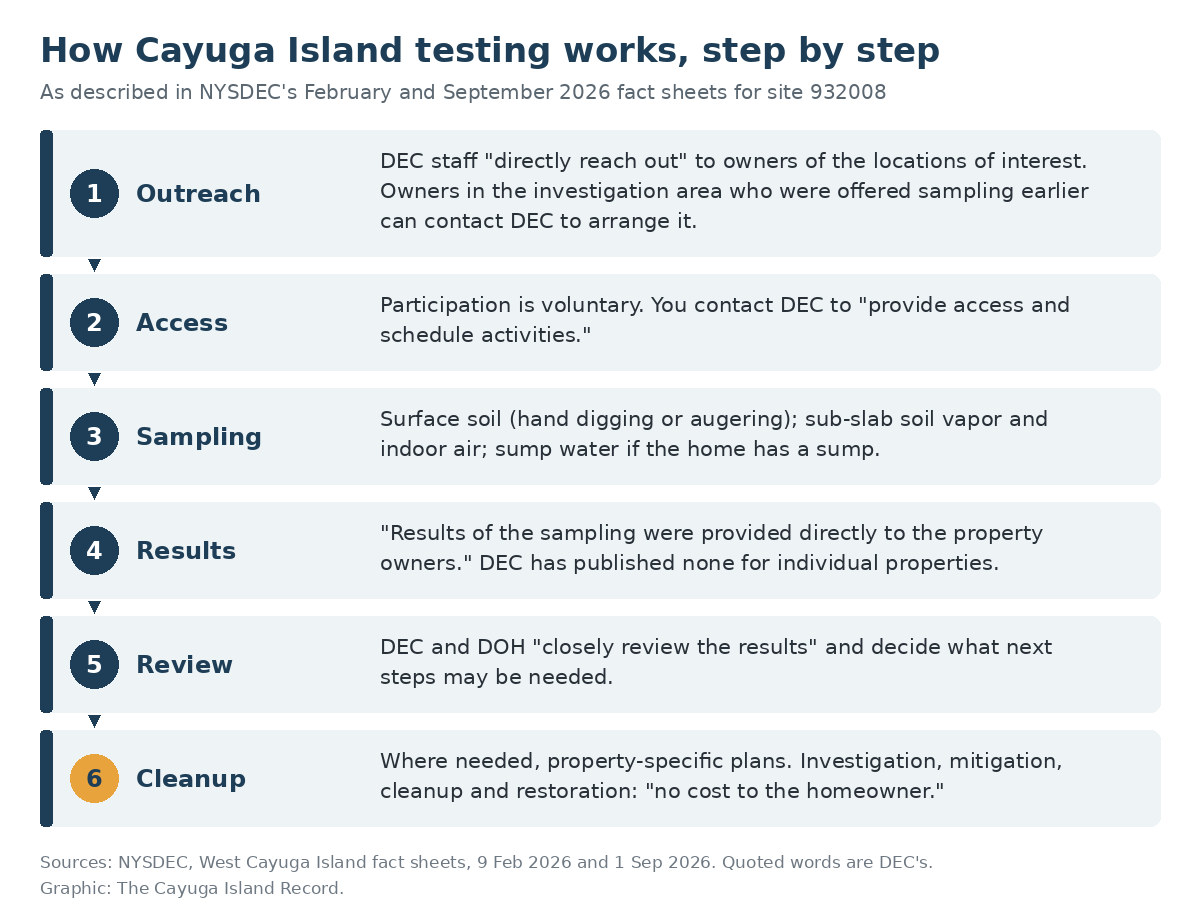
DEC describes the work as a phased investigation of private properties on the island’s western tip. In February 2026 it “initiated outreach to potentially impacted property owners on the westernmost tip.” In September it began a second phase: “Offers will be extended to sample certain additional properties along West Rivershore Drive” (Primary: DEC fact sheet, 1 Sep 2026).
DEC says its staff “will directly reach out to property owners of the locations of interest.” It has not published a map or boundary of those locations, so we do not draw one. If you are not sure whether you are inside the area, ask DEC.
If you were contacted before and did not respond, the door is still open. DEC “will also accommodate any property owners within the investigation area who were previously offered sampling and have not yet arranged for the investigation” (Primary: DEC fact sheet, 1 Sep 2026).
Accounts differ on who else can ask
| Reporting: The Buffalo News | Commentary: island property owner |
|---|---|
| DEC contacted 12 more owners just east of the first 22 on 8 September 2026, and four agreed. A DEC official said “we have not hit clean (soil) yet, as far east as we were able to sample.” | J. Gary DiLaura writes that DEC told him “there will be no more tests unless requested by homeowners” and that “they did the six who requested.” |
| Buffalo News, 25 Sep 2026, syndicated | DiLaura blog, 10 Oct 2026 |
The two accounts also differ on the count (seven sampled versus six). DEC has published nothing that settles either point. The Buffalo News also reported that one resident, Natalie Gigliotti, “had also called the DEC” after hearing about the investigation in June. Neither fact sheet says whether DEC will test properties outside its locations of interest on request.
Step 2: Contact DEC
The fact sheets name two contacts. The names, titles, phone numbers and emails below are copied exactly as printed in both the 9 February and 1 September 2026 fact sheets (Primary).
| NYSDEC | NYSDOH | |
|---|---|---|
| Name | Sarah Whiteway | Daniel (Dan) Tucholski |
| Title | Public Participation Specialist | Public Health Specialist II – Bureau of Environmental Exposure Investigation |
| Phone | (716) 851-7192 | (518) 486-7016 |
| sarah.whiteway@dec.ny.gov | beei@health.ny.gov | |
| Address | 700 Delaware Avenue, Buffalo, NY 14209 | Empire State Plaza – Corning Tower, Albany, NY 12237 |
For access and scheduling, DEC’s September fact sheet says: “Please reach out to the DEC contact information below to provide access and schedule activities.” DOH’s contact sits in its Bureau of Environmental Exposure Investigation. Our for residents page keeps the same contacts.

Step 3: Agree to access
Testing happens only where owners say yes. DEC describes the properties it has sampled as those “where owners have provided voluntary access” (Primary: DEC fact sheet, 1 Sep 2026).
Neither fact sheet describes the access paperwork. If you are asked to sign something, ask DEC to explain it, and take any legal questions to your own attorney.
Timing matters. The February fact sheet says: “Timely responses to the sampling offer are critically important, particularly for the soil vapor intrusion and indoor air assessments, to help plan and conduct testing during the winter heating season.” It explains why: “Winter is the best time to assess soil vapor intrusion since heating systems are generally in operation and doors and windows are closed” (Primary: DEC fact sheet, 9 Feb 2026).
Step 4: What the sampling involves
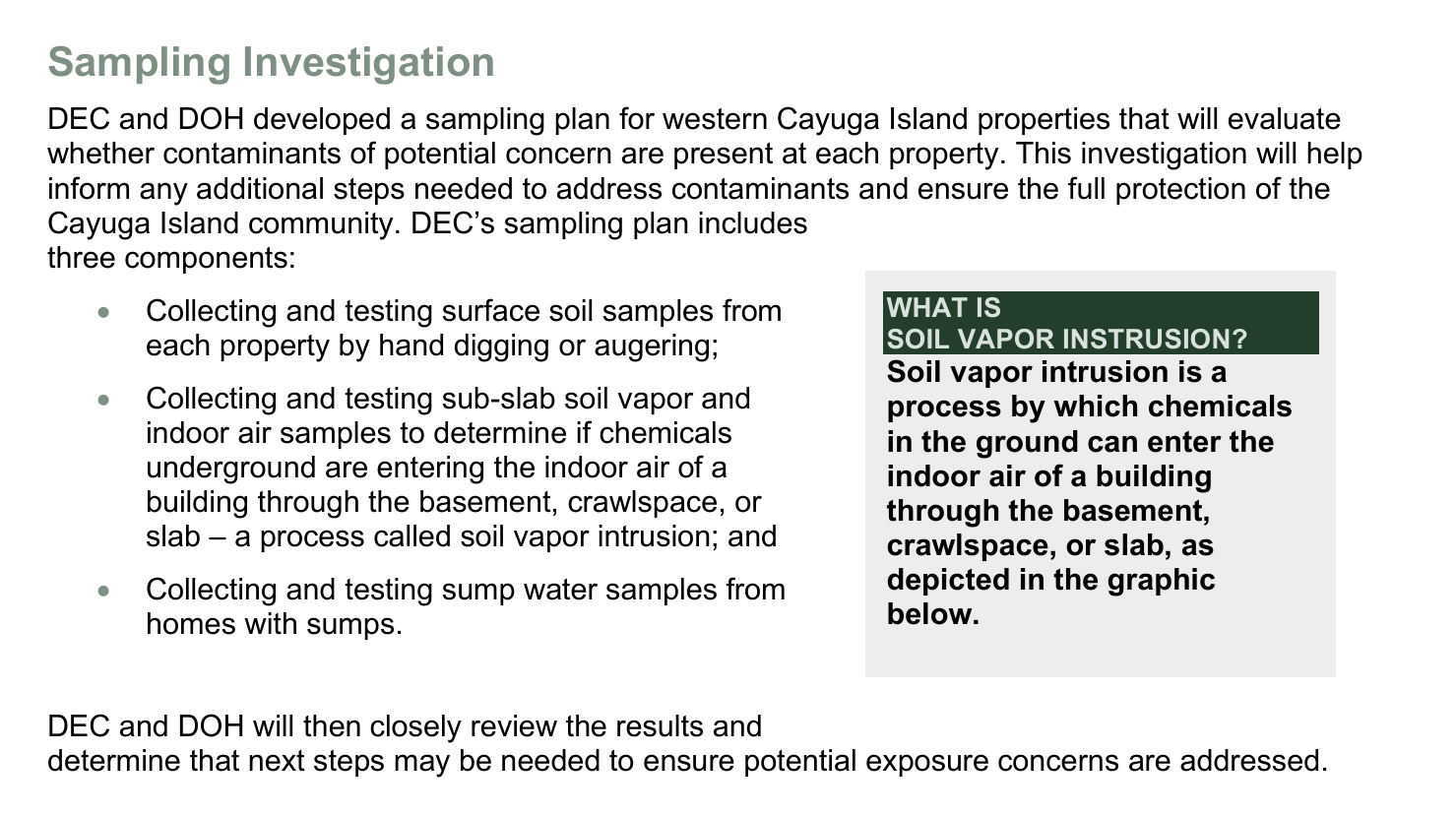
DEC’s sampling plan has three parts. This is how DEC itself lists them:
Surface soil
Samples are collected “by hand digging or augering.” The February fact sheet said “at up to four locations from each property”; the September version gives no number (Primary: Feb 2026 and Sep 2026 fact sheets).
Sub-slab soil vapor and indoor air
These samples check whether chemicals underground “are entering the indoor air of a building through the basement, crawlspace, or slab,” which DEC calls soil vapor intrusion. DOH says such investigations “typically” collect soil vapor, sub-slab vapor, indoor air and outdoor air samples (Primary: DOH, Soil Vapor Intrusion). DOH also notes that everyday products such as paints, cleaners and new carpets can affect indoor air. For why this pathway matters here, see what was found.
Sump water
Only “from homes with sumps.”
Step 5: Results and next steps
“Results of the sampling were provided directly to the property owners and property-specific plans to address any contamination needing mitigation are underway,” DEC says. DEC and DOH then “closely review the results” and decide what next steps may be needed (Primary: DEC fact sheet, 1 Sep 2026). Neither fact sheet says how long results take.
For indoor air, DOH lists the usual outcomes: no further action, additional sampling, monitoring, or mitigation. Mitigation can include sealing foundation cracks, adjusting heating and ventilation, or “installing a sub-slab depressurization system beneath the building” (Primary: DOH, Soil Vapor Intrusion).
What has happened at the first homes comes from reporting, not from DEC documents. The Buffalo News reported that one of the first seven sampled homes had unhealthy indoor air and DEC installed a venting system. It also reported that all seven “will have the top 2 feet of soil removed and replaced,” with work expected in 2027 (Reporting: Buffalo News, 25 Sep 2026, syndicated). The paper also printed concentration figures from DEC data. DEC has not published them, so we do not repeat them.
What it costs
Nothing, according to DEC: “All work associated with a property investigation, any recommended mitigation, cleanup, and restoration of properties to pre-cleanup conditions will be completed at no cost to the homeowner” (Primary: DEC fact sheet, 1 Sep 2026).
The February wording covered “investigation, cleanup, and restoration”; September added “any recommended mitigation.” Paying for a private lab is a different matter. DOH’s general gardening guidance says private soil testing “can be expensive and the test results can be hard to interpret” (Primary: DOH, Healthy Gardening).
Before you dig, and while you wait
The oldest instruction on record still applies. After the 1992 and 1993 assessments, DEC and DOH sent each owner a notice of the levels found, and told owners “they should contact DEC or DOH if they were going to be performing ground-intrusive work on their properties” (Primary: DEC fact sheet, 1 Sep 2026). Those reports are explained in our walk-through of the 1984–1993 reports.
DOH’s general advice for any gardener worried about soil chemicals, not written for Cayuga Island, includes raised beds with clean soil “at least ten inches deep,” gloves, washing up with soap and water, and watching that young children do not eat soil (Primary: DOH, Healthy Gardening). For anything about your own household’s health, call DOH.
Where this fits
Testing is separate from the island’s listing status. The site is DEC Class P, “Potential,” which DEC says needs a site characterization to decide whether it belongs on the state Registry. Our Superfund explainer covers what that means. Every document cited here is in our document library, and the full sequence is on our timeline.
Frequently asked questions
Is Cayuga Island soil testing really free?
Yes, by DEC’s own description. Investigation, any recommended mitigation, cleanup and restoration “will be completed at no cost to the homeowner.”
Do I have to allow testing?
No. DEC describes sampling at properties “where owners have provided voluntary access.”
What samples does DEC take?
Surface soil by hand digging or augering, sub-slab soil vapor with indoor air, and sump water from homes with sumps.
Who gets my results?
You do. DEC says results were “provided directly to the property owners.” DEC has published no results for individual properties.
I was offered testing earlier and didn’t respond. Is it too late?
No. DEC says it will accommodate owners in the investigation area who were offered sampling and have not yet arranged it. Contact Sarah Whiteway at (716) 851-7192 or sarah.whiteway@dec.ny.gov.
I rent my home. Can I ask for testing?
The fact sheets speak only of property owners. Ask DEC how it handles tenants, and tell your landlord about the offer.
When is the best time to test?
DEC says winter is the best time to assess soil vapor intrusion, because heating systems are running and doors and windows are closed.
Sources are labeled Primary (agency documents), Reporting (named news outlets) or Commentary (opinion). We publish no figure DEC has not published itself and never identify an individual property. Last verified 16 November 2026.
