Last verified 9 November 2026. This is an independent record, not a government site, and nothing here is legal, medical, or real-estate advice.
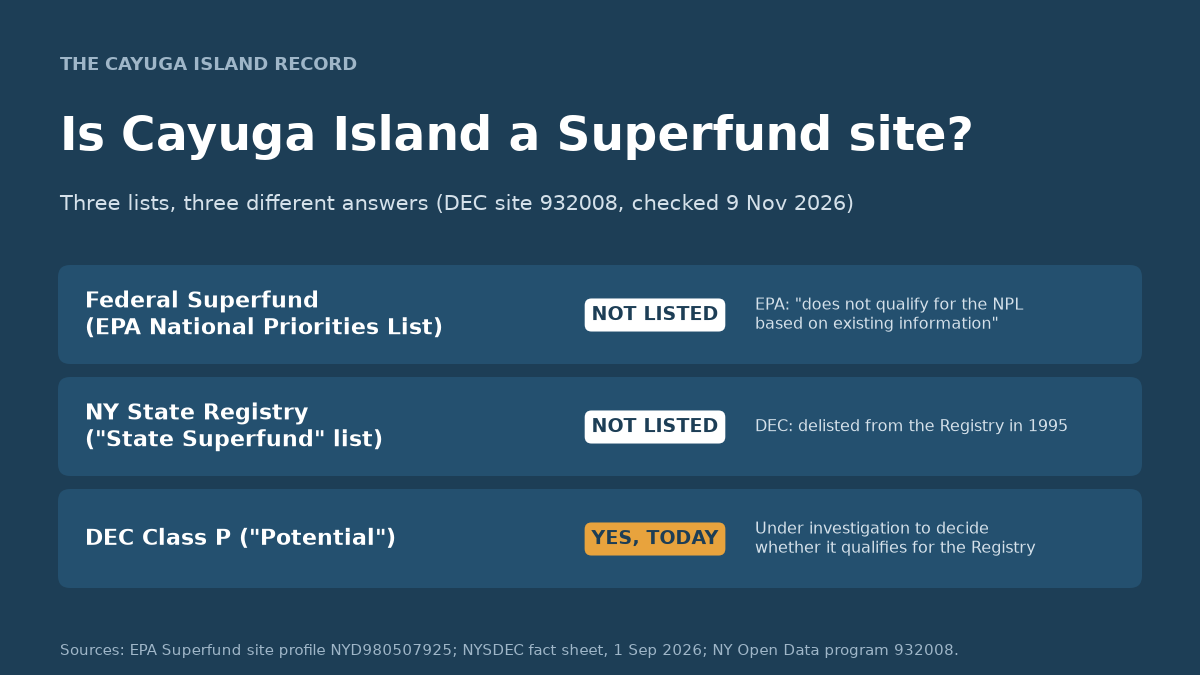
Since the state’s investigation of the island’s west end became news in June 2026, one question keeps coming up: is Cayuga Island a Superfund site? The short answer is no. But the word “Superfund” means two different things in New York, and the island has a history with both. This post sorts out the labels using only what the agencies themselves publish.
If you are new to the story, start with Cayuga Island: what we know, then come back here.
Key takeaways
- Cayuga Island (DEC site 932008) is Class P, “Potential.” That is a New York State code for a site still being looked at, not a listing.
- It is not on EPA’s federal Superfund list, the National Priorities List. EPA says it “does not qualify for the NPL based on existing information.”
- It is not on New York’s Registry of Inactive Hazardous Waste Disposal Sites, often called the “State Superfund” list. DEC says it was delisted in 1995.
- Class P is not a verdict either way. DEC says a site characterization decides whether a Class P site belongs on the Registry.
Two kinds of “Superfund”
People use “Superfund” for two separate government programs:
| Federal Superfund | New York “State Superfund” | |
|---|---|---|
| Run by | U.S. EPA | NYSDEC, with the state Health Department |
| The list | National Priorities List (NPL) | Registry of Inactive Hazardous Waste Disposal Sites |
| How a site gets on | Usually a Hazard Ranking System score of 28.50 or higher | Evidence of hazardous waste disposal plus a significant threat (Class 2) |
| Cayuga Island today | Not on the NPL | Not on the Registry (delisted 1995) |
Sources: EPA, NPL one-pager and site assessment process; NYSDEC, Site Classifications; DEC fact sheet, 1 Sep 2026.
The federal list
EPA’s Superfund program keeps the National Priorities List, “the list of sites of national priority among the known releases or threatened releases of hazardous substances” (Primary: EPA, NPL). EPA says the most common way onto it is a Hazard Ranking System score of 28.50 or more. A state can also name one top-priority site, and a federal health advisory can qualify a site (Primary: EPA, NPL one-pager).
EPA’s database carries the island as “Cayuga Island LF,” ID NYD980507925. Its NPL status is “Not on the NPL.” Its other status reads “NFRAP-Site does not qualify for the NPL based on existing information” (Primary: EPA site profile, checked 9 November 2026). NFRAP stands for No Further Remedial Action Planned. EPA explains that sites that do not qualify “remain with the state” (Primary: EPA, site assessment process). We could not find a public record of when EPA made that decision.
Love Canal, nearby in LaSalle, is a federal NPL site (Primary: EPA, Love Canal profile). That closeness is one reason the two get confused. Being near a Superfund site does not change Cayuga Island’s status.
The state list
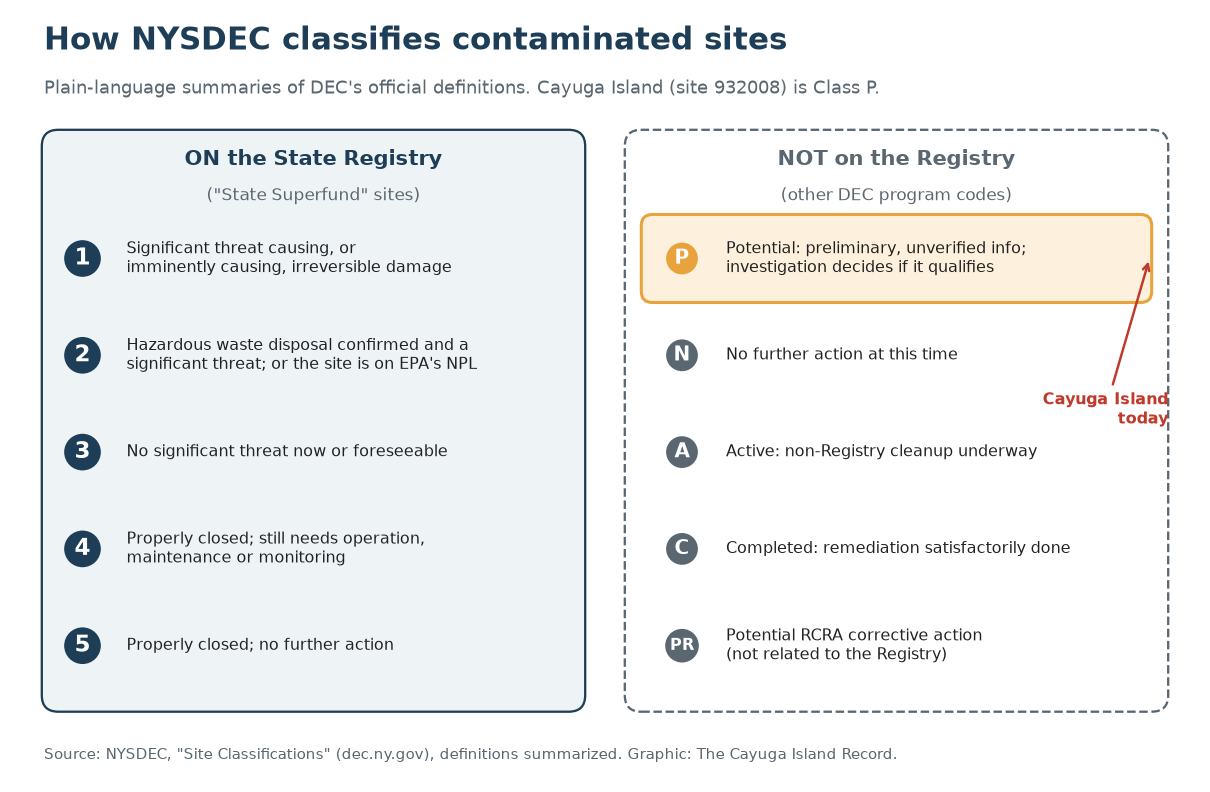
New York keeps its own list, the Registry of Inactive Hazardous Waste Disposal Sites. DEC says it is “commonly referred to as the list of State Superfund Sites.” To be placed on it, “there must be evidence that hazardous waste was disposed on the site and that any resulting contamination presents a significant threat (or reasonably foreseeable threat) to public health or the environment” (Primary: DEC, Site Classifications).
Registry sites carry number classes, 1 through 5. Sites outside the Registry carry letter codes: P, N, A, C and PR.
What Class P means
DEC’s definition, in full context, is worth reading slowly. Class P “is used for sites where preliminary information indicates that a site may have contamination that makes it eligible for consideration for placement on the Registry.” DEC adds: “Further information and/or investigation, in the form of a site characterization, is needed to determine if a Class P site qualifies for listing.” It also notes that “Class P sites are not listed on the Registry and many are eventually found to not qualify,” and are then usually reclassified Class N (Primary: DEC, Site Classifications).
The state’s Open Data record lists Cayuga Island as Class P at “West Rivershore Drive.” It names six contaminants: alpha-BHC, beta-BHC, mercury, trichloroethene (TCE), cis-1,2-dichloroethene and 1,1-dichloroethene (Primary: NY Open Data, program 932008, checked 9 November 2026). For what each of those is, see what was found.
Two agency statements, side by side
DEC’s general description of Class P and its specific fact sheet on Cayuga Island read differently. We show both rather than choose:
| DEC on Class P sites in general | DEC on Cayuga Island specifically |
|---|---|
| The information for a P site “is preliminary in nature and unverified and that no DEC investigation has yet been completed.” | Findings from participating properties “confirmed some impacts to indoor air and soil,” and DEC and DOH “are beginning a second phase of investigations.” |
| Site Classifications | Fact sheet, 1 Sep 2026 |
Both can be true at once. The class code describes where the formal Registry decision stands. It does not measure how much contamination has been found, and DEC has not announced the result of a site characterization for the island.
How the island got here: 1984 to 2026
The label has changed several times. Every step below is from an agency document unless marked.
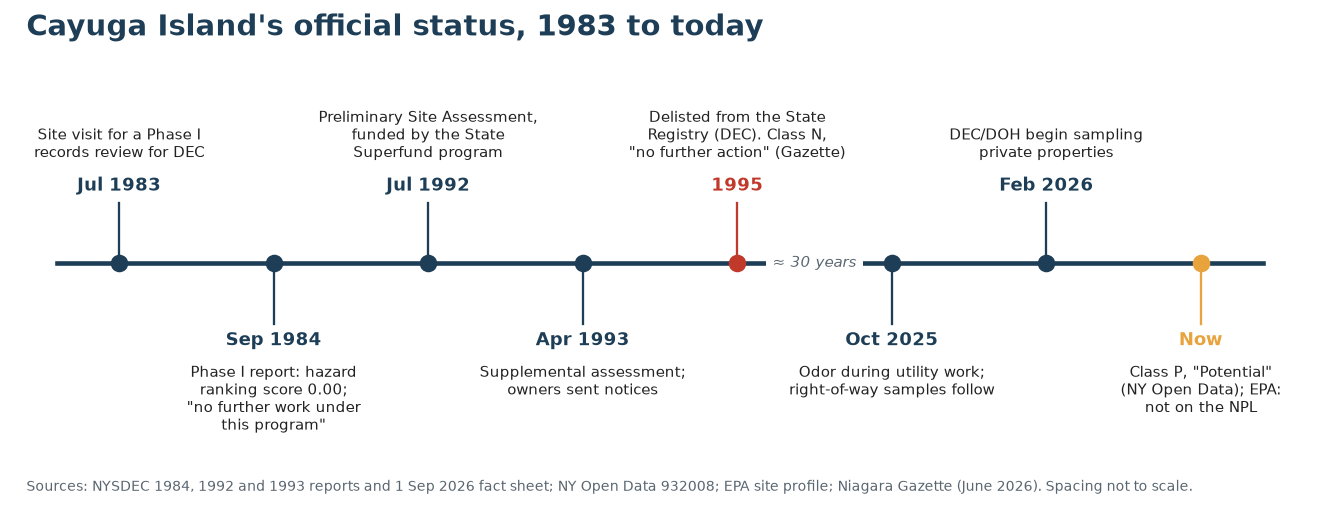
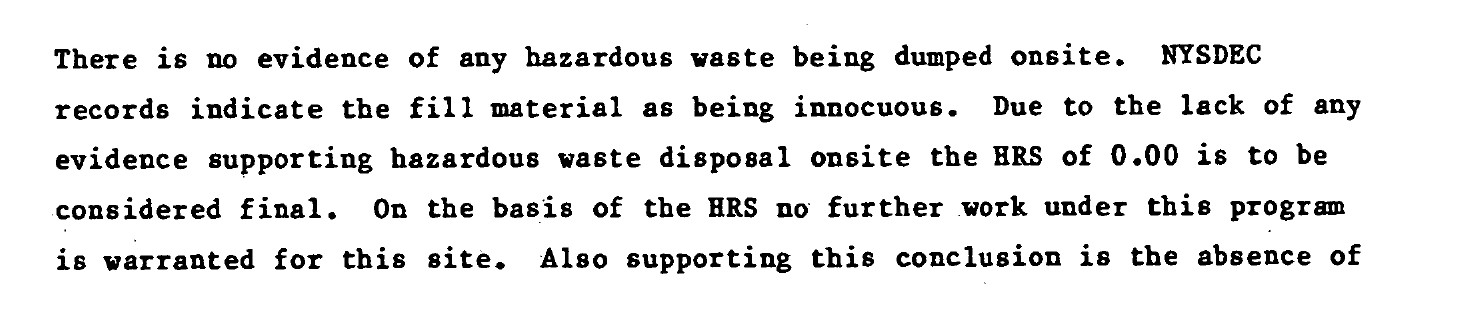
1984: a score of zero. A Phase I records review for DEC applied EPA’s Hazard Ranking System and gave the island a score of 0.00. With no sampling data, it relied on DEC records that described the fill as “innocuous” (Primary: 1984 Phase I report, PDF p. 4). Our walk-through of the 1984–1993 reports explains why that review found nothing.
1992–1993: State Superfund money, and a Registry number. The 1992 and 1993 assessments carry “Site Registry No. 9-32-008” on their covers. Both say the work was paid for with “funds allocated under the New York State Superfund program” (Primary: 1992 report, PDF p. 7; 1993 report). The documents we have do not state which class the site held then. DEC later sent each owner a notice of the levels found (Primary: DEC fact sheet, 1 Sep 2026).
1995: off the Registry. “The site was delisted from the State’s registry of Inactive Hazardous Waste Disposal Sites in 1995” (Primary: DEC fact sheet, 1 Sep 2026). DEC told the Niagara Gazette that 1995 was also the year it designated the western end Class N, “no further action” (Reporting: Niagara Gazette, June 2026, reposted). Island property owner J. Gary DiLaura has published what he says is a 1994 DEC letter approving a petition “to delist Cayuga Island” (Commentary: DiLaura blog, 10 Oct 2026). We have not seen the letter itself.
2025–2026: back to Class P. After soil data collected during 2025 utility work showed contaminated fill, DEC sampled the West Rivershore Drive right-of-way. It cited that new data, “the historic use of fill in creating Cayuga Island, and revised requirements for addressing contamination” as the reasons it began a phased investigation (Primary: DEC fact sheet, 1 Sep 2026). Today’s state record shows Class P. The full sequence is on our timeline.
Could Cayuga Island become a Superfund site?
Nothing published says it will. Here is what the rules allow:
- State Registry. If a site characterization finds hazardous waste disposal and a significant threat, DEC’s definitions point to Class 2, which is on the Registry. If not, the usual next step for a P site is Class N (Primary: DEC, Site Classifications).
- Federal NPL. EPA’s status says “based on existing information.” EPA notes that “a Site Reassessment may also be performed to gather and evaluate new information at a site” (Primary: EPA, site assessment process). No such reassessment of Cayuga Island has been announced.
“For all sites in a Department remedial program, the goal of investigating and remediating a site is that the result must be protective of public health and the environment regardless of whether the site is on the Registry or not.” — NYSDEC, Site Classifications
In other words, by DEC’s own description, the class does not decide whether a cleanup happens. The Buffalo News has reported that DEC plans to replace the top 2 feet of soil at the first seven sampled properties, expected in 2027 (Reporting: Buffalo News, 25 Sep 2026, syndicated). That plan is moving ahead while the site stays Class P.
Who is paying, and is anyone liable?
DEC says all investigation, mitigation, cleanup and restoration work on a property “will be completed at no cost to the homeowner” (Primary: DEC fact sheet, 1 Sep 2026). In June, Assemblyman Angelo Morinello told WBEN that any remediation would be covered under the State Superfund program: “the expense will be borne by the Superfund” (Reporting: WBEN, 16 Jun 2026). That is a statement about funding, not about the island’s listing.
DEC has not named any responsible party. A DEC regional official told The Buffalo News its attorneys are “trying to seek information from who we consider potential responsible parties” and that “that work is ongoing” (Reporting: Buffalo News, 25 Sep 2026, syndicated). EPA also notes that placing a site on the NPL “does not assign liability to any party or to the owner of any specific property” (Primary: EPA, NPL one-pager).
What residents can do now
The class does not change how to get help. DEC and DOH are offering testing to owners in the study area. Contacts and steps are on our for residents page, and every document cited here is linked from our document library. If you spot an error, our corrections log explains how we fix it.
Frequently asked questions
Is Cayuga Island a Superfund site?
No. It is not on EPA’s National Priorities List, and it is not on New York’s Registry of Inactive Hazardous Waste Disposal Sites. DEC lists it as Class P, “Potential.”
What does Class P mean?
It means preliminary information suggests a site may qualify for the state Registry, and a site characterization is needed to decide. DEC says Class P information is “preliminary in nature and unverified.”
Was Cayuga Island ever on the State Registry?
DEC says the site “was delisted from the State’s registry” in 1995, and its 1992 and 1993 reports carry a Registry number. The documents posted so far do not say which class it held before delisting.
Why does EPA say it doesn’t qualify?
EPA’s profile says “NFRAP-Site does not qualify for the NPL based on existing information.” We could not find the date or score behind that decision. A 1984 review done for DEC scored the site 0.00.
Does Class P mean my property is contaminated?
No. Class P applies to the site as a whole and is not a finding about any single property. Owners in the study area receive their own results directly from DEC.
Is anyone being sued over Cayuga Island?
We have found no lawsuit about Cayuga Island. DEC has not named a responsible party; its attorneys are reported to be seeking information.
Sources are labeled Primary (agency documents), Reporting (named news outlets) or Commentary (opinion). We publish no figure DEC has not published itself and never identify an individual property. Last verified 9 November 2026.